
Updated October 2026.
What separates a professional-grade hydrogen inhalation generator from a cheap one?
Verifiable specifications, not price. The differences that matter are how much hydrogen (not total gas) a machine delivers, whether the output is adjustable, what is in the gas stream, whether purity and safety testing are documented, and what the warranty and return terms cover. Price is a weak proxy: some lower-priced machines document their specifications well, and some expensive ones do not.
How can I tell how much hydrogen a generator really delivers?
Look for the hydrogen figure in mL/min, not the total gas figure. Machines that produce hydrogen and oxygen together may advertise the combined flow, and a lye-based machine’s stream is only about two-thirds hydrogen. If a listing gives one number and doesn’t say whether it is hydrogen or total gas, ask.
Then ask what that flow means for your breathing. A 2026 respiratory-physiology modeling paper (LeBaron et al.) supports a practical window of about 1-4% fraction of inspired hydrogen (FiH₂), and finds that flow rate alone cannot predict FiH₂ because breathing rate, nasal patency, breathing pattern, and elevation all change the result. Very low output can fall short of that range for many people, and very high output can exceed the 4% level where hydrogen in air becomes a flammability concern. That is why adjustable output matters more than the biggest number on the box. See Hydrogen Inhaler Flow Rate: Why It Matters for the math.
How should I evaluate hydrogen purity claims?
Ask for a test report that names the model, the laboratory, and the date. Unsourced figures such as “99.9999%” tell you little. PEM (proton exchange membrane) machines generate hydrogen separately from oxygen, so a purity figure is meaningful for that stream. For Revive’s HYD line, independent laboratory testing (QTT, June 2023) measured 99.992% hydrogen purity on the generator platform. For more on what these numbers mean, see Hydrogen Purity: What Does 99.99% Mean?
What do CE, RoHS, and ISO 9001 actually mean?
- CE (EMC and LVD): The product meets European electromagnetic-compatibility and low-voltage electrical safety requirements. It is not a medical-device clearance.
- RoHS: The product restricts certain hazardous substances in its materials.
- ISO 9001: The manufacturer operates a certified quality-management system. It describes the factory’s process, not the machine’s performance.
None of these is FDA clearance, and none should be read as one. Treat them as evidence of basic electrical, materials, and manufacturing discipline, and ask to see the actual certificates.
A buyer’s checklist
| Ask | Why it matters | Revive HYD line |
|---|---|---|
| How many mL/min of hydrogen, not total gas? | Total-gas figures overstate hydrogen on mixed-gas machines | HYD-1500: 600 / 900 / 1,000. HYD-1800: up to 1,200. HYD-3000: up to 2,000 across both hydrogen ports; 500 / 750 / 1,000 on a single port |
| Can I adjust the output? | FiH₂ depends on your breathing; you need room to go up or down | Three selectable flow settings on every model |
| Is hydrogen separated from oxygen? | Determines what is in the stream you breathe | PEM: generated and delivered separately |
| What goes in the tank? | Affects upkeep and handling | Distilled water only (TDS 5 or less); 6 L tank with integrated UV-C water treatment |
| Is there a purity test report? | Verifies the number, not just the claim | 99.992% (QTT, June 2023) |
| Which certifications, and can I see them? | Basic electrical and materials compliance | CE (EMC/LVD) and RoHS reports; manufacturer ISO 9001 |
| How long is the warranty, and what does it exclude? | Scope matters more than length | 3-year limited warranty (details) |
| What does a return cost if nothing is wrong? | Returns are where terms differ most | 30-day window from delivery (details) |
Dual-user modes split output between users, so check per-user figures when comparing machines. Each HYD model also has a selectable 1-8 hour timer.
Frequently asked questions
Is a cheap hydrogen generator worth buying?
It can be, if the seller documents hydrogen output, purity, safety testing, and return terms. The risk with very low-priced machines is usually missing documentation, not the price itself. If a listing cannot tell you how many mL/min of hydrogen the machine delivers, that is worth treating as a warning sign.
Do I need a professional-grade machine for home use?
You need documented output, adjustability, and sound safety design. Whether you call that “professional-grade” matters less than whether you can verify it. Clinics and shared-use settings add durability and dual-user considerations.
How much hydrogen should a generator produce?
There is no single right number. Research suggests a FiH₂ of about 1-4%, and the flow that reaches that range varies from person to person. An adjustable machine lets you settle within the range rather than hoping a fixed output lands there.
Can I compare machines without buying them?
Yes. Compare published specifications, lab reports, certificates, and policies. Our side-by-side comparisons cover lye-based machines and HLTH, and our price guide lays out the cost trade-offs.
About research and wellness use
Research on molecular hydrogen explores selective antioxidant activity and signaling pathways such as Nrf2, and continues to develop. It is a wellness area with ongoing study, not an established treatment. Browse summaries in the Science Hub.
See the Revive HYD generators
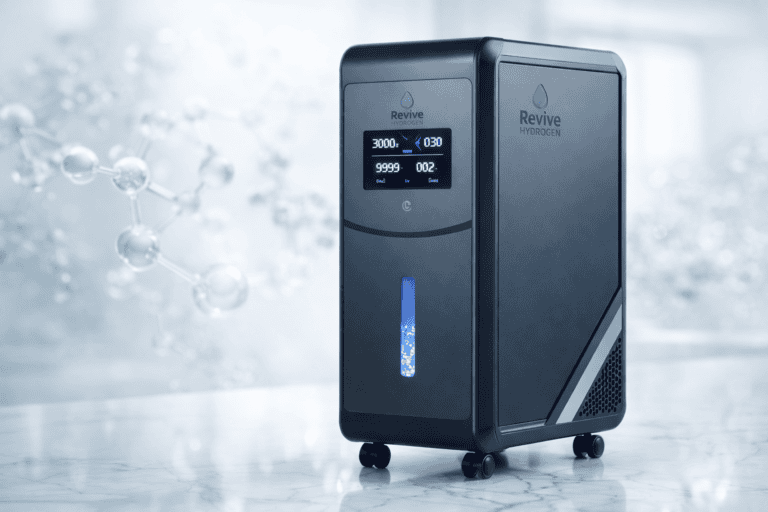
Revive Hydrogen, based in Dry Ridge, Kentucky, sells the HYD-1500, HYD-1800, and HYD-3000 PEM generators, manufactured by Olive Electronic Technology in Zhengzhou, China. Compare the models on the comparison page, browse the generators, or download the free Beginner’s Guide to Hydrogen Inhalation.
Source: LeBaron TW, Ohno K, Salomez-Ihl C, et al. Respiratory-physiology modeling of therapeutic hydrogen inhalation: defining the fraction of inspired hydrogen (FiH₂) and flow-rate requirements. Respir Res. 2026;27:259. doi:10.1186/s12931-026-03664-9
These statements have not been evaluated by the Food and Drug Administration. This product is not intended to diagnose, treat, cure, or prevent any disease.