
Updated October 2026.
Is hydrogen inhalation better than hydrogen water?
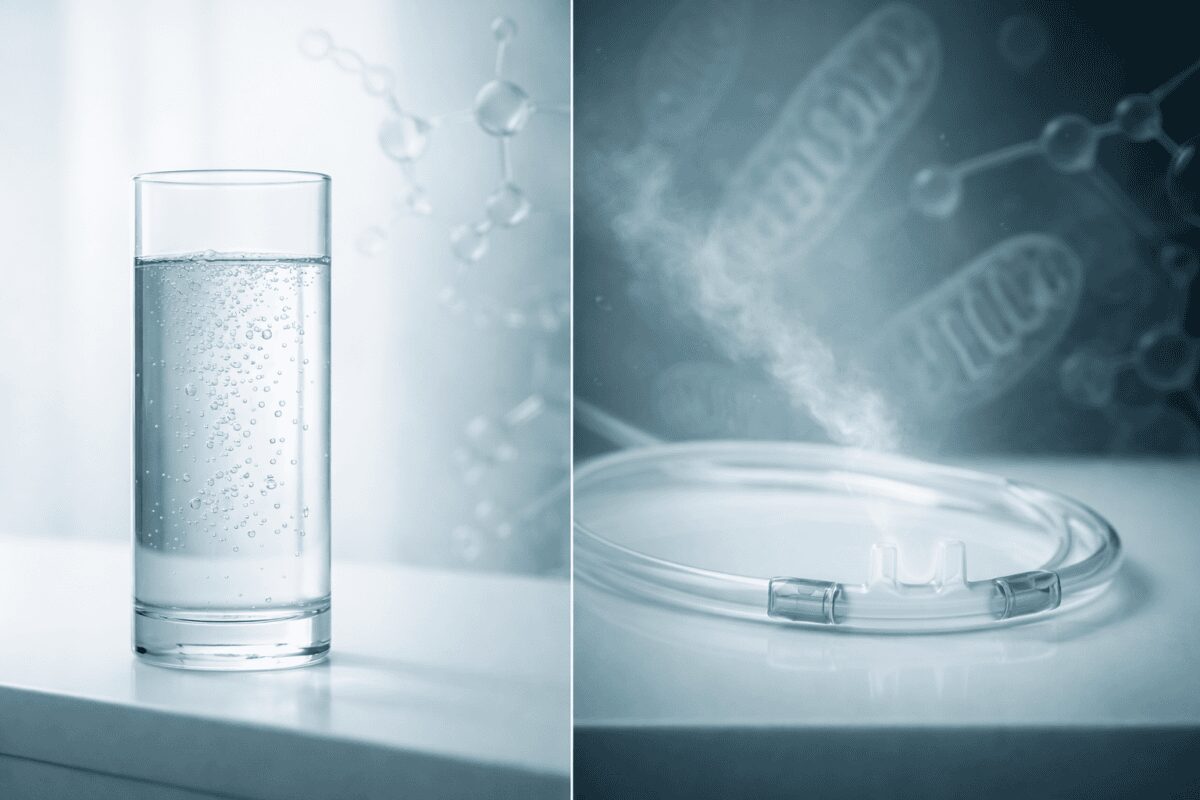
They are different delivery tools, not interchangeable versions of the same thing. Hydrogen water holds about 1.6 ppm of dissolved hydrogen at most under room pressure and is consumed in a drink. Inhalation delivers a continuous stream of hydrogen in the air you breathe over a session, typically 30-60 minutes, and the dose depends on the fraction of inspired hydrogen (FiH₂), which research suggests should fall around 1-4%. Research on both is still developing, so this page compares delivery, not health outcomes.
How does hydrogen water work?
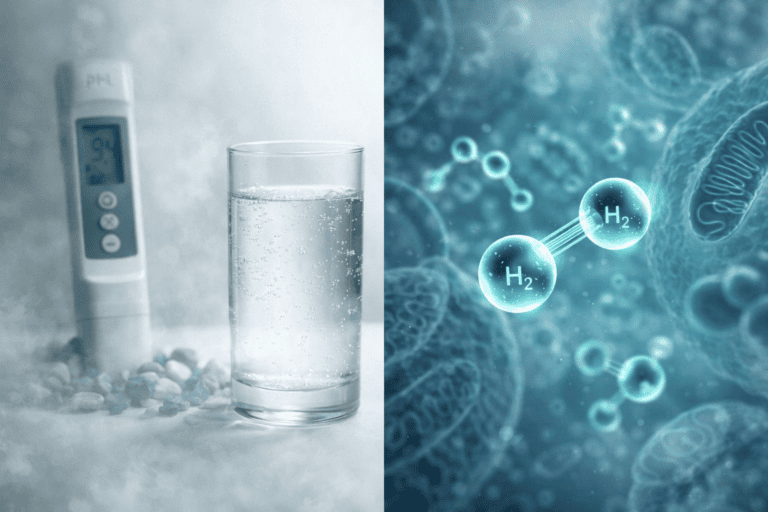
Hydrogen water is made by dissolving hydrogen gas into water, typically reaching 0.5-1.6 ppm. Hydrogen is the smallest molecule, so it escapes from solution quickly once a container is opened, and even sealed containers lose concentration over time. The water is then absorbed through the digestive tract. A liter at the maximum of about 1.6 ppm contains roughly 1.6 mg of hydrogen, about 18 mL of gas.
How does hydrogen inhalation work?
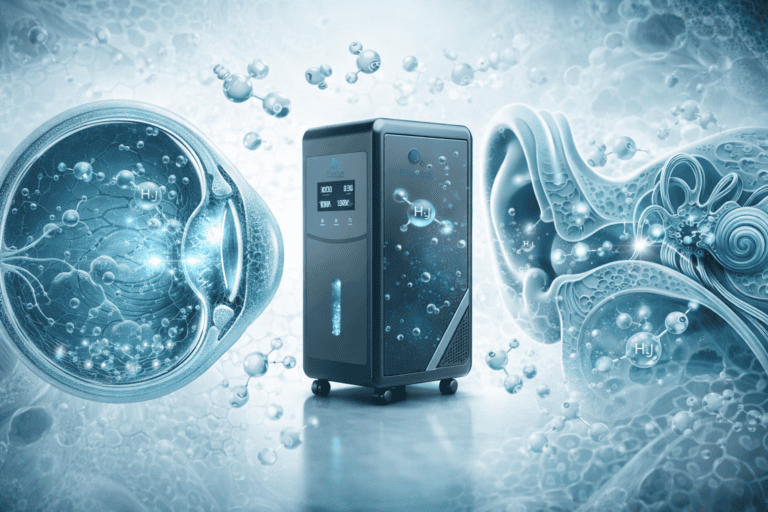
An inhalation generator splits distilled water into hydrogen and oxygen, and hydrogen is delivered through a nasal cannula so it mixes with the air you breathe. Hydrogen is small and nonpolar, and it diffuses readily across membranes, including the lung’s alveolar membrane. The dose is described by FiH₂, the share of hydrogen in each breath, rather than by how much gas the machine produces.
A 2026 respiratory-physiology modeling paper (LeBaron et al.) supports a practical FiH₂ window of about 1-4%. It also finds that flow rate alone cannot predict FiH₂, because breathing rate, nasal patency, breathing pattern, and elevation all affect it, and that above about 4% hydrogen in air becomes a flammability concern. For that reason, the volume of gas a machine releases and the amount of hydrogen in a drink cannot be compared directly as doses.
Hydrogen inhalation vs. hydrogen water: side-by-side
| Hydrogen water | Hydrogen inhalation | |
|---|---|---|
| How it is delivered | Dissolved in water, swallowed | Gas mixed into inhaled air via nasal cannula |
| How the amount is described | Concentration, up to about 1.6 ppm | FiH₂, with a practical window of about 1-4% |
| Duration | As long as it takes to drink; hydrogen escapes over time | Continuous for the length of the session, typically 30-60 minutes |
| Equipment | Bottle, tablet, or dissolving system | Generator, humidification bottle, nasal cannula |
| Convenience | Portable; drink anywhere | Stationary; a seated session at home |
| Upfront cost | Low to moderate | Higher; Revive’s HYD line lists at $3,299-$4,299 |
Can I use my inhalation generator to make hydrogen water?
We do not recommend it. An electrolyzer like the one in Revive’s generators is designed to run at near-atmospheric pressure. A dissolving rod creates back pressure that transmits to the electrolyzer, which can stress the membrane and shorten its life. A dedicated hydrogen water bottle is the better tool, and a hydrogen water bottle is included with every generator purchase. The humidification cup included with the generator bubbles hydrogen lightly through water only to add moisture to the gas stream; it does not make drinking-quality hydrogen water.
How do I choose between them?
- Hydrogen water may suit you if you want a low-cost, portable option you can use anywhere, and a lower upfront investment matters most.
- Inhalation may suit you if you prefer a scheduled daily routine at home, want adjustable and repeatable sessions, and are comfortable with a larger upfront investment.
- Many people use both, with a portable bottle for on-the-go and a generator for home sessions.
Published research on molecular hydrogen includes both forms of delivery. Browse the Science Hub for study summaries, and keep in mind that results from one delivery method should not be assumed to apply to the other.
What should I look for in a hydrogen inhalation generator?
- Hydrogen output, not total gas. Ask how many mL/min of hydrogen the machine delivers. Mixed-gas machines deliver roughly two-thirds hydrogen.
- Adjustable output. Because FiH₂ depends on your breathing, being able to turn output up or down matters more than a single high number. At the typical resting inspiratory flow, 500 / 750 / 1,000 mL/min of hydrogen corresponds to roughly 1.7 / 2.5 / 3.3% FiH₂.
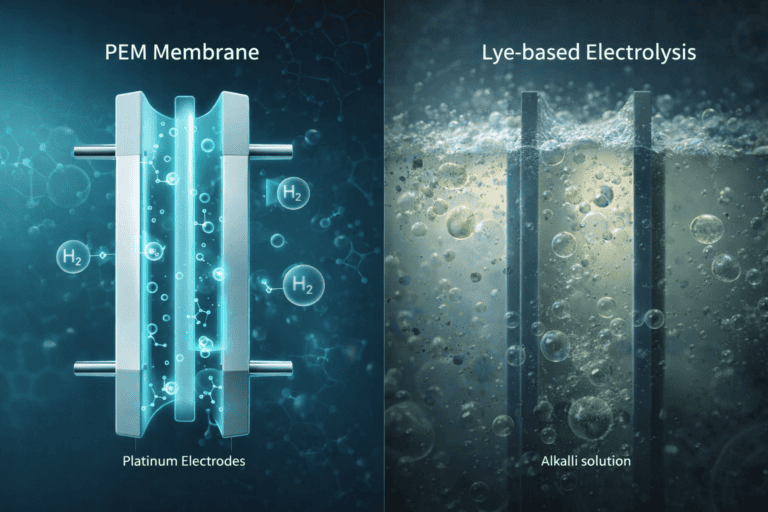
- Electrolysis type. PEM machines use distilled water only; lye-based machines use a customer-mixed electrolyte. See PEM vs. lye.
- Documentation. Look for published purity testing, safety and electrical certifications, and a clearly scoped warranty. CE and RoHS cover electrical and materials compliance, not medical clearance.
- Return terms. Ask what a return costs if nothing is wrong.
Frequently asked questions
Can I use hydrogen water and inhalation together?
Yes. They are separate delivery methods, and some people use a portable bottle during the day and a generator for scheduled home sessions.
How long should a hydrogen inhalation session last?
Revive’s manual describes a typical session as 30-60 minutes. The timer is selectable from 1 to 8 hours, with a maximum of 10 hours of continuous running followed by a 1-hour cooldown.
What is FiH₂?
FiH₂ is the fraction of inspired hydrogen: the share of hydrogen in the air you breathe in. It is a better description of an inhalation dose than the machine’s flow rate, and a 2026 modeling paper supports a practical window of about 1-4%. Our flow rate guide explains how to think about it.
Does hydrogen water lose its hydrogen?
Yes. Hydrogen escapes from water quickly once a container is opened, and even sealed containers lose concentration over time, so freshness matters.
See the Revive HYD generators
Revive Hydrogen, based in Dry Ridge, Kentucky, sells the HYD-1500, HYD-1800, and HYD-3000 PEM generators, manufactured by Olive Electronic Technology in Zhengzhou, China. Each has three selectable flow settings, a 6-liter tank with integrated UV-C water treatment, a selectable 1-8 hour timer, and a 3-year limited warranty. Independent laboratory testing (QTT, June 2023) measured 99.992% hydrogen purity on the generator platform. Compare the models on the comparison page, browse the generators, or download the free Beginner’s Guide to Hydrogen Inhalation.
Related reading: Hydrogen and Cellular Health · Hydrogen Generator Price Guide
Source: LeBaron TW, Ohno K, Salomez-Ihl C, et al. Respiratory-physiology modeling of therapeutic hydrogen inhalation: defining the fraction of inspired hydrogen (FiH₂) and flow-rate requirements. Respir Res. 2026;27:259. doi:10.1186/s12931-026-03664-9
These statements have not been evaluated by the Food and Drug Administration. This product is not intended to diagnose, treat, cure, or prevent any disease.