

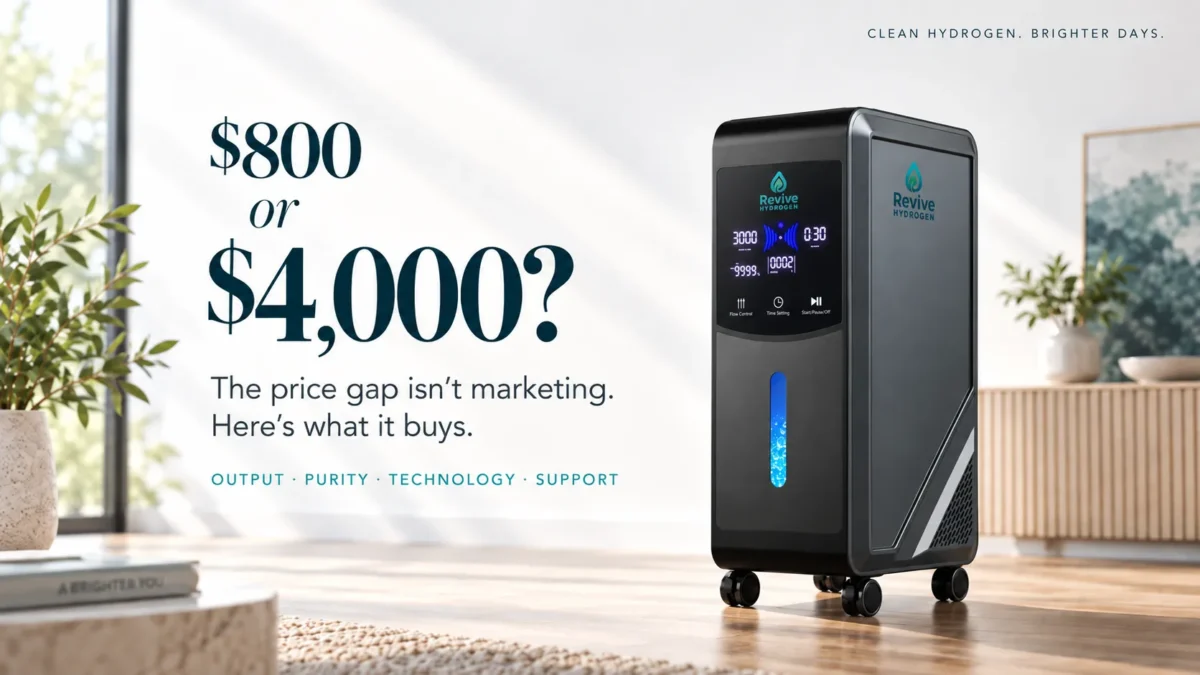
If you’ve spent any time shopping for a hydrogen inhalation generator, you’ve noticed something strange. There are units on Amazon for a few hundred dollars. There are units that cost more than a used car. And in the photographs, they can look remarkably similar — same white or graphite housing, same blue-lit water window, same cannula coiled beside them.
So what accounts for a gap that large?
It’s a fair question, and it deserves a real answer rather than “you get what you pay for.” Below are the five things that actually drive the price difference. Some of them matter a great deal. One or two of them matter less than the marketing suggests. All of them are things you can check for yourself before you spend anything.
1. How much hydrogen the machine actually produces
This is the single biggest driver of cost, and it’s the one most often buried in the fine print.
Hydrogen output is measured in milliliters per minute (mL/min). Inexpensive units frequently produce somewhere in the range of 100–250 mL/min. Higher-output systems produce ten times that or more.
The reason this drives price so hard is physical, not marketing. Producing more hydrogen per minute requires a larger electrolysis cell stack, more electrode surface area, more power, and more thermal management. A unit drawing 750 watts is a fundamentally different machine from one drawing 60 watts, and it costs more to build. There’s no clever engineering shortcut around it.
How to check: look for a stated mL/min figure on the spec sheet. If a listing advertises only “high concentration” or “high purity” without a flow number anywhere, that’s worth noticing. The number is the specification. Everything else is adjective.
2. Whether you’re getting hydrogen — or hydrogen mixed with oxygen
This one surprises most buyers, and it’s the distinction that separates whole categories of machine.
Water electrolysis splits H₂O into hydrogen and oxygen. What happens next is a design decision. Some systems separate the two gases and deliver hydrogen only, venting the oxygen. Others deliver the mixture as it comes off the cell — roughly two parts hydrogen to one part oxygen, sometimes marketed under names like oxyhydrogen or Brown’s gas.
Separating the gases requires additional membrane and manifold engineering, which costs money. Units that skip that step are cheaper to build, and their output is a different product from separated hydrogen at high purity.
How to check: ask directly whether the unit outputs separated hydrogen or a hydrogen-oxygen mixture, and ask for the stated purity figure. Ours is 99.992% H₂, and that figure has been independently verified by third-party testing rather than self-reported.
3. What the cell is made of, and what you have to put in it
There are two common approaches to the electrolysis cell itself.
Alkaline systems use a liquid electrolyte solution — often a potassium hydroxide mixture — to carry current through the water. They’re less expensive to manufacture. They also require you to buy, handle, and periodically replace that electrolyte, and they introduce the possibility of electrolyte carryover into the gas stream if the separation stage isn’t well designed.
PEM (proton exchange membrane) systems, sometimes called SPE, use a solid polymer membrane instead of a liquid electrolyte. They run on distilled water alone — nothing added, nothing to mix. The membrane and its precious-metal catalyst coating are a significant share of the machine’s cost, which is a real part of why PEM units sit higher on the price scale.
How to check: find out which technology the unit uses, and find out what you’re required to add to the water. “Distilled water only” and “add electrolyte solution every X hours” describe two different ownership experiences and two different price tiers.
4. Whether anyone besides the seller has tested it
Any manufacturer can print a number on a spec sheet. The meaningful question is whether an independent laboratory ever measured it.
Third-party testing is not free. Safety and electromagnetic compliance testing — the work behind CE marking, RoHS, LVD, and EMC certification — runs into real money per product line, and it’s one of the least visible costs folded into a higher price. It’s also the cost most easily skipped by a seller competing purely on price.
How to check: ask for the actual test reports, not a logo on a product page. A seller who has them will send them. Our CE, RoHS, EMC, and LVD documentation is available on request, along with the independent purity verification.
5. What happens after you’ve paid
The cheapest machines are often the most expensive to own, because the relationship ends at the transaction.
The questions worth asking: How long is the warranty, and what does it actually cover? Is there a US-based phone number, or only an email form? Are replacement parts available in a year — cannulas, filters, cell components? What’s the expected service life, and does the seller have a track record long enough to make that estimate mean anything?
A generator is a piece of equipment you plug in and run for hours a week over years. Support and parts availability aren’t extras. They’re most of what you’re buying after the hardware itself.
How to check: call the number before you order. Notice who answers.
So is the expensive machine always the right one?
No — and any seller who tells you otherwise is selling, not advising.
If you want to try hydrogen inhalation without committing several thousand dollars, an inexpensive unit is a legitimate way to find out whether the routine fits your life at all. Just buy it understanding what it is: lower output, likely a gas mixture rather than separated hydrogen, and probably no independent verification of either.
What you shouldn’t do is buy an inexpensive unit believing it’s the same thing as a high-output separated-hydrogen system in a cheaper box. It isn’t, and the price gap is telling you so.
Compare the specifications before you compare the prices. If two machines genuinely match on output, purity, technology, testing, and support, then by all means buy the cheaper one. In our experience, they rarely do.
Revive Hydrogen generators — HYD-1500 (1,500 mL/min), HYD-1800 (1,800 mL/min), HYD-3000 (3,000 mL/min). PEM electrolysis, distilled water only, 99.992% independently verified H₂ purity, 30-day in-home trial, 3-year limited warranty, US-based support.
See the full specifications and in-home trial →
Revive Hydrogen generators are intended for general wellness purposes and are not medical devices. They are not intended to diagnose, treat, cure, or prevent any disease. If you have a health condition or are pregnant, consult your physician before use.