

Why Hydrogen Might Work More Like a Workout Than a Pill
For years, the leading explanation for how molecular hydrogen (H₂) works in the body was simple: it was thought to act like a selective antioxidant, quietly neutralizing a specific type of harmful free radical. That story made intuitive sense — but it never fully explained everything researchers were seeing in hydrogen studies. Two studies, published eight years apart, are starting to fill in a more complete — and more interesting — picture.
The old theory: hydrogen as a quiet scavenger
The “antioxidant” explanation cast hydrogen as passive — something that floats through the body, finds harmful oxygen radicals, and neutralizes them. It’s not wrong, exactly, but newer research suggests it’s incomplete. A more active process appears to be at work.
What a 2025 study found: hydrogen has a specific target
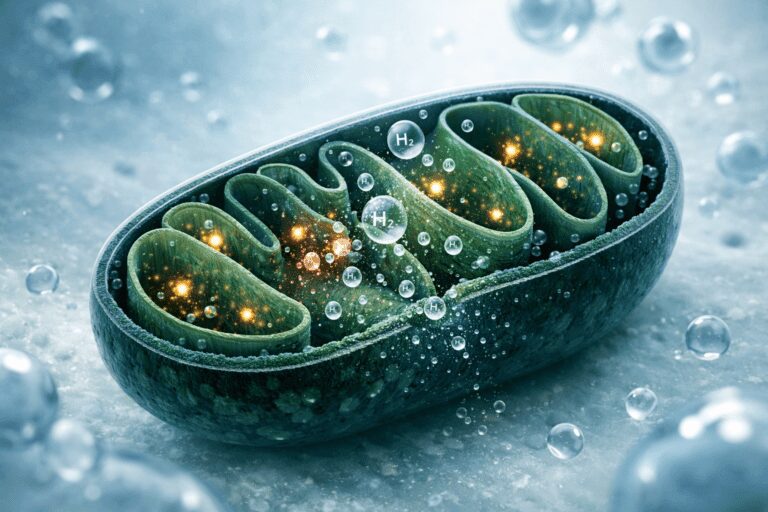
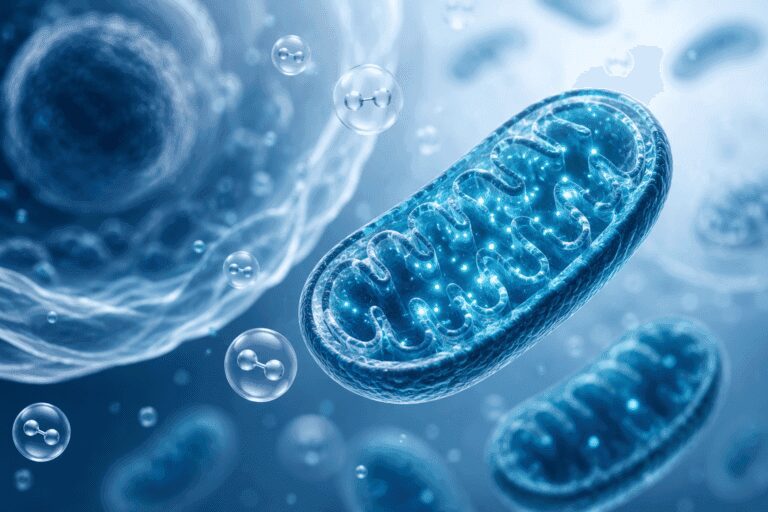
In late 2025, a research team (Negishi et al., published in Redox Biology) identified something no one had pinned down before: a specific protein that hydrogen interacts with inside mitochondria — the energy-producing structures inside our cells.
That protein is called the Rieske iron-sulfur protein (RISP), and it’s part of Complex III, one of the key machines your mitochondria use to produce energy. The researchers found that RISP has a structural similarity to enzymes that bacteria use specifically to process hydrogen gas — which may explain why hydrogen interacts with it at all.
Here’s what they observed: when cells (and mouse liver tissue) were exposed to H₂, RISP got broken down and rebuilt by the cell’s internal quality-control system. Energy production dipped briefly in the process — but that dip triggered something important: a repair-and-upgrade program called the mitochondrial unfolded protein response (UPR^mt). This program increases the cell’s supply of protective “chaperone” proteins and clears out damaged components, leaving mitochondria running better than before.
An earlier study already saw the downstream effect — in neurons
This actually connects to an earlier, separate line of research. Back in 2017, a team led by Ohsawa (published in PLoS ONE) studied how hydrogen affected human neuron-like cells (SH-SY5Y cells, a standard neuroscience research model) under oxidative stress.
They found that hydrogen exposure caused a brief spike in a specific type of reactive molecule inside mitochondria — along with a temporary dip in the cell’s glutathione (a key internal antioxidant buffer). At first glance, that might sound like a bad thing. But the cells responded to this small stress by ramping up their own antioxidant defenses (through a pathway called Nrf2).
Here’s the detail that mattered most: cells that received hydrogen before a bigger oxidative stress were protected. Cells that received hydrogen after the stress were not. That timing pattern is the signature of an adaptive, “training” response — not a simple scavenging effect. If hydrogen worked only by mopping up free radicals directly, timing shouldn’t matter nearly this much.
Putting the two studies together
The 2017 study saw the effect: a small mitochondrial stress that trained neurons to handle bigger challenges better. The 2025 study offers a plausible explanation for the cause: hydrogen interacting with RISP, right at the site in the mitochondria known to generate exactly that kind of stress signal when disrupted.
Put together, the two studies tell a coherent story across eight years and two different research groups: hydrogen appears to work less like a passive cleanup crew, and more like a small, deliberate nudge — similar to how a hard workout slightly stresses muscle fibers so the body rebuilds them stronger, or how a cold shower briefly stresses the body to trigger better resilience. Scientists call this pattern mitohormesis: a small, controlled stress that trains a system to become more resilient.
Why this points toward a habit, not a one-time fix
This is the big takeaway: in the 2017 study, hydrogen only worked when it was given ahead of time. That’s not how a treatment for an existing problem works — that’s how a training stimulus works.
This mirrors how exercise, sauna, cold exposure, and other well-studied hormetic practices work. None of them are typically used to treat an already-existing problem in the moment — they work because a person builds them into a routine, so the body’s protective systems (like Nrf2 and UPR^mt) stay primed and ready.
It’s also worth noting that hormesis research generally shows this is a “sweet spot” relationship, not a “more is always better” one. Small, regularly spaced stimulation appears to build resilience; too much or too frequent a stimulus can overwhelm the same systems. So the emerging picture supports thinking about hydrogen inhalation the way you’d think about a fitness habit — consistent and moderate — rather than something you reach for occasionally in response to a specific problem.
The bottom line
Two studies, eight years apart, point toward the same underlying idea: hydrogen may support the body’s own cellular resilience and repair systems through a small, repeatable stress-and-adapt cycle — rather than by directly treating any particular condition. That framing — a supportive daily practice for mitochondrial health, not a fix for a specific ailment — is where the current science actually points.
For those seeking to integrate molecular hydrogen into comprehensive wellness strategies, Revive Hydrogen offers professional-grade hydrogen inhalation technology designed for home and clinical use, built around the kind of consistent, daily practice this research points to.
Sources:
- Negishi, S., Ito, M., Hasegawa, T., et al. (2025). The Rieske iron-sulfur protein is a primary target of molecular hydrogen. Redox Biology. DOI: 10.1016/j.redox.2025.103952
- Murakami, Y., Ito, M., & Ohsawa, I. (2017). Molecular hydrogen protects against oxidative stress-induced SH-SY5Y neuroblastoma cell death through the process of mitohormesis. PLoS ONE, 12(5), e0176992. DOI: 10.1371/journal.pone.0176992