

Can Hydrogen Inhalation Improve Sleep? A New Randomized Trial Offers an Interesting Clue
If you’ve ever done 2 a.m. math — counting the hours left until the alarm, wondering if tonight’s the night you’ll actually feel rested tomorrow — you’re in very good company. Sleep problems are one of the most common health complaints out there, and they rarely travel alone. Poor sleep and a rough mood tend to show up together, each one making the other harder to shake.
That’s part of why a recent clinical trial caught our attention. Researchers at two hospitals in China set out to test whether inhaling a hydrogen-oxygen gas mixture could make a measurable difference for people already struggling with sleep — and whether any benefit would carry over into mood as well.
What the researchers did
The study, published in Medical Gas Research in 2026, enrolled 66 adults with diagnosed sleep disorders, including chronic insomnia. Participants were randomly split into two groups: 41 received seven days of nasal hydrogen-oxygen inhalation, while 25 served as a control group.
To keep the results honest, the researchers didn’t rely on self-report alone. Everyone wore a wrist actigraph — a motion-sensing device similar to a fitness tracker — throughout the week to objectively log sleep and wake patterns. Participants also completed three validated questionnaires before and after treatment: the PSQI (sleep quality), the Self-Rating Anxiety Scale (SAS), and the Self-Rating Depression Scale (SDS).
What they found
After seven days, the hydrogen-oxygen group showed meaningful improvement compared to the control group:
- Sleep quality (PSQI) improved significantly
- Mood scores (SDS) improved significantly
- Actigraphy backed up the self-reports — the hydrogen-oxygen group showed increased total sleep time and reduced wake time compared with the control group. Sleep efficiency also improved from baseline within the treatment group.
Interestingly, anxiety scores (SAS) didn’t show a significant difference between the two groups. That’s actually a useful detail — it suggests this wasn’t simply a case of people feeling better across the board because they were in a study. The effect showed up specifically for sleep and low mood, not uniformly across every measure researchers tracked.
Why might this happen?
Researchers still don’t know. Molecular hydrogen has been studied for effects on oxidative stress, inflammatory signaling, and cellular stress-response pathways, all of which can intersect with sleep and mood regulation. Those mechanisms could potentially help explain the findings. But this trial didn’t measure oxidative stress, inflammation, or any other biological pathway directly. It measured sleep and mood outcomes — so for now, the mechanism remains a hypothesis.
Practical Considerations for Hydrogen and Sleep Support
Integrating molecular hydrogen into a sleep-focused wellness routine requires thoughtful implementation. While research is promising, hydrogen is not a standalone solution—it functions best as part of a broader approach to circadian health that includes light exposure management, consistent sleep-wake timing, stress mitigation, and nutritional optimization.
Most protocols in the literature involve daily sessions of 30–120 minutes, often in the evening or before bed, to align antioxidant support with the body’s natural repair window. Users report subjective improvements in sleep onset latency, reduced nighttime awakenings, and enhanced morning alertness, though individual responses vary.
It is essential to emphasize that hydrogen therapy should not replace evidence-based sleep hygiene practices or medical evaluation for sleep disorders such as obstructive sleep apnea, insomnia, or restless leg syndrome. Rather, H₂ may serve as a complementary tool for those seeking to optimize cellular health and resilience in support of better rest.
Bring This Technology Home
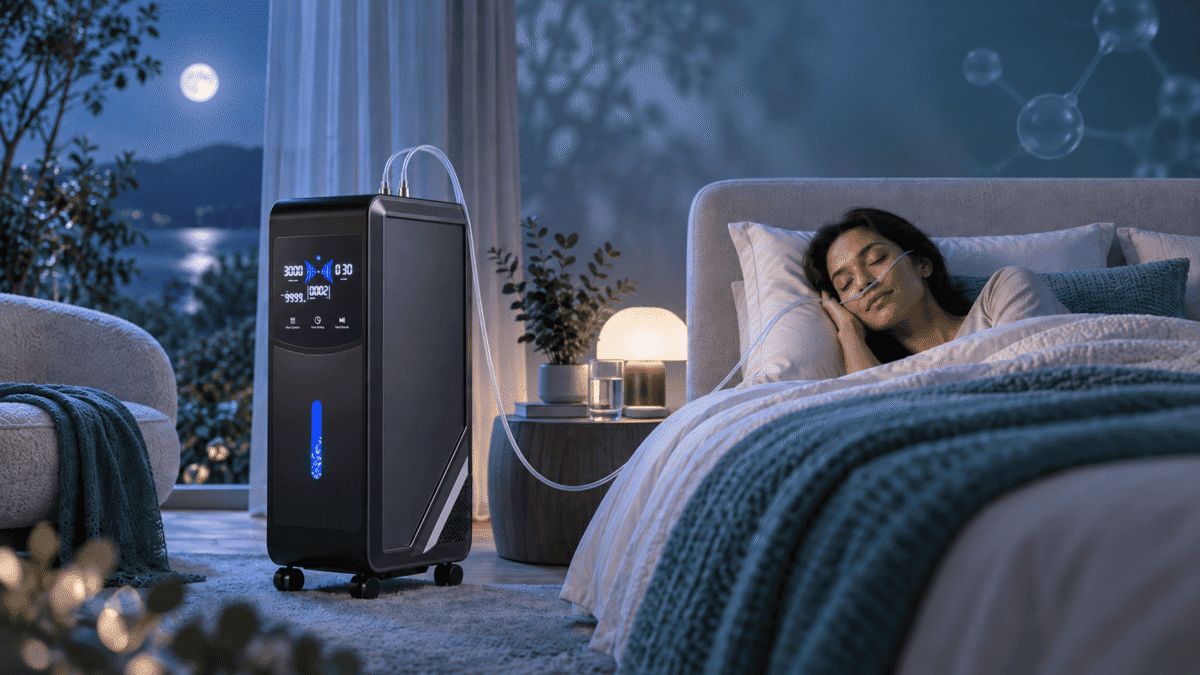
For individuals and practitioners interested in exploring the potential of molecular hydrogen inhalation, access to reliable, high-output technology is paramount. Revive Hydrogen offers the Intelligent High-Flow Hydrogen Generator, engineered specifically for professional-grade home and clinical wellness applications.
Built on PEM (Proton Exchange Membrane) electrolysis, the system utilizes platinum-coated titanium electrodes and a DuPont N117 membrane to generate molecular hydrogen at a verified purity of 99.992%—independently confirmed by an accredited third-party laboratory. Unlike diluted hydrogen-air mixtures common in competitor devices, Revive’s generators produce pure H₂ output alongside separate oxygen, ensuring consistent, therapeutic-grade saturation.
The platform is available in three tiers—HYD-1500, HYD-1800, and HYD-3000—offering scalable output to meet individual or shared-use needs. All models include nasal cannula delivery, programmable session timers from 30 to 480 minutes, UV-C water disinfection, and the ability to run continuously for up to eight hours. Manufactured to CE and RoHS standards within an ISO 9001-certified quality management system, each unit is backed by a comprehensive three-year limited warranty covering defects in materials and workmanship.
As research into hydrogen and sleep continues to evolve, having access to a dependable, lab-grade hydrogen generator positions users at the forefront of cellular wellness innovation—empowering them to integrate cutting-edge science into their daily routine with confidence and precision.
As always, if you’re dealing with ongoing sleep or mood concerns, it’s worth looping in your doctor — this research is encouraging, but it’s early, and it’s not a substitute for medical care.
Source: Gao YH, Chen J, Zhong H, Zhao Q. "Effect of hydrogen–oxygen inhalation on sleep disorders and abnormal mood: a single-blind, randomized controlled trial." Medical Gas Research. 2026;16(2):98–102.
