
Brown’s Gas: Does the Extra Oxygen Actually Provide Any Benefit?
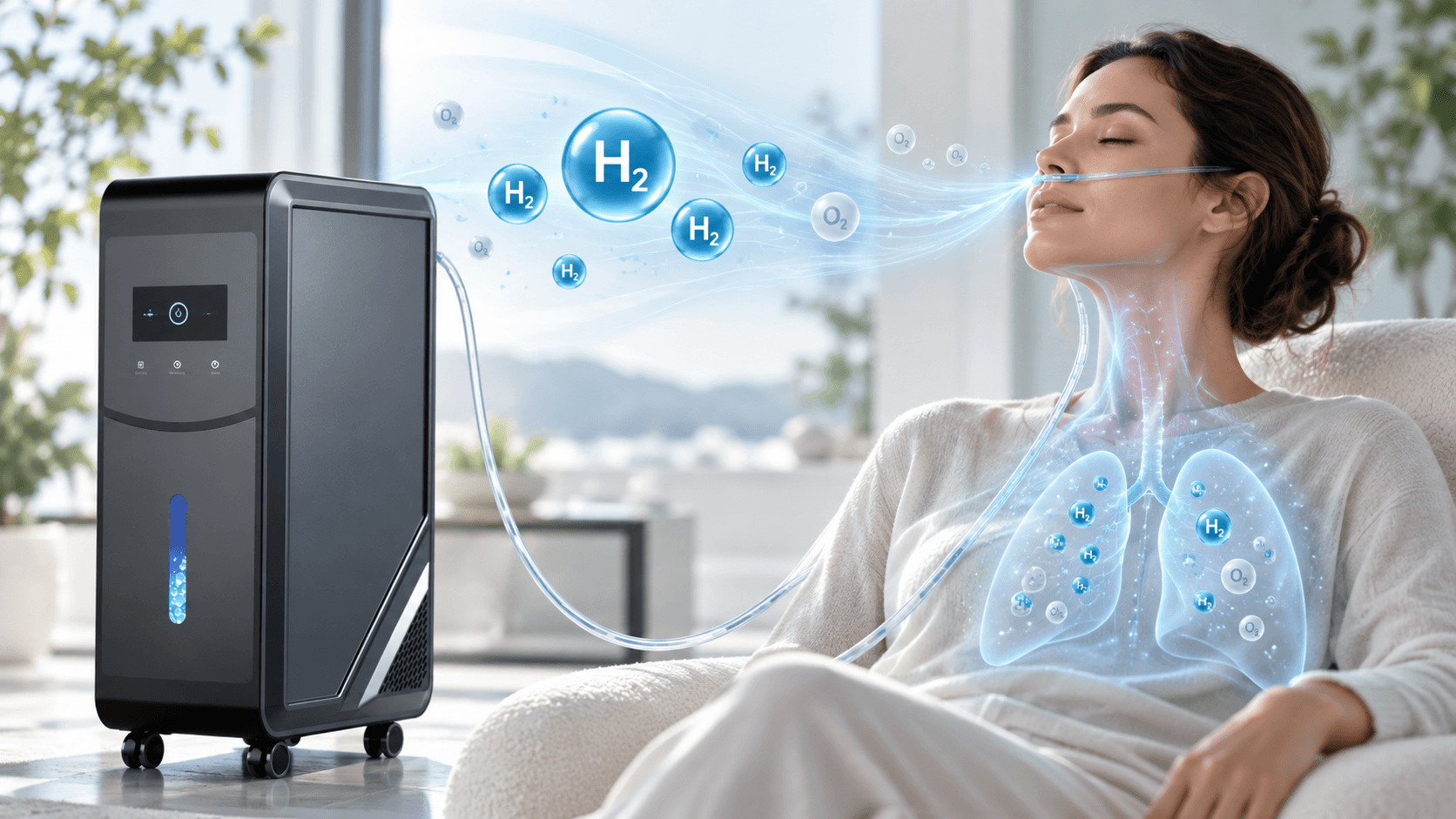
Brown’s gas (oxyhydrogen) contains approximately 67% hydrogen and 33% oxygen. But does that extra oxygen actually provide a therapeutic benefit?
A 2026 study published in Respiratory Research suggests that, for healthy individuals, the answer is largely no. At the flow rates used by most commercial oxyhydrogen generators, the amount of additional oxygen actually inhaled is surprisingly small.
33% Oxygen Sounds Impressive—Until You Do the Math
Consider the AquaCure AC60, an oxyhydrogen generator that produces 1,000 mL/min of combined hydrogen and oxygen gas.
That output consists of approximately:
- 667 mL/min hydrogen (H₂)
- 333 mL/min oxygen (O₂)
At first glance, 333 mL/min of extra oxygen sounds significant. But there’s an important catch: you’re already breathing air that contains approximately 21% oxygen.
The hydrogen and oxygen coming from the generator partially displace that ordinary air. After accounting for this displacement, the net additional oxygen is only about 123 mL/min.
And there’s another factor. With a nasal cannula, gas flows continuously, including while you’re exhaling. Not all of that supplemental oxygen is actually inhaled.
Using the respiratory assumptions modeled in the study, only about 40 mL of additional oxygen is inspired.
The result?
Your inspired oxygen concentration (FiO₂) increases from approximately 21% to just 21.36%.
The researchers compare this tiny change to descending about 160 meters (525 feet) in altitude—roughly 45 stories.
That’s hardly meaningful oxygen supplementation for someone with normal lung function.
So Where Do the Potential Benefits Come From?
The answer is molecular hydrogen (H₂).
Unlike oxygen, which already makes up 21% of the air we breathe, molecular hydrogen is virtually absent from ordinary air.
When an oxyhydrogen generator supplies hydrogen through a nasal cannula, it introduces a gas that wasn’t previously present at physiologically relevant concentrations.
Hydrogen is being investigated for its effects on oxidative stress, cellular signaling, inflammatory pathways, and other biological processes.
Importantly, the study found no scientific evidence that oxyhydrogen provides greater therapeutic benefits than hydrogen alone when the actual inspired hydrogen concentration (FiH₂) is equivalent.
The authors explain:
“Mechanistically, the small amount of supplemental oxygen delivered at typical flow rates is unlikely to exert meaningful physiological effects.”
In other words, if oxyhydrogen inhalation produces beneficial biological effects in a healthy individual, the evidence points primarily to the hydrogen—not the additional oxygen.
More Oxygen Isn’t Necessarily Better
There are situations where supplemental oxygen is medically important, particularly for people with impaired lung function and low blood oxygen saturation.
At considerably higher oxyhydrogen flow rates, the oxygen contribution can become clinically relevant.
But for healthy individuals with normal oxygen saturation, supplemental oxygen generally isn’t necessary.
There is also a safety consideration: combining hydrogen and oxygen creates an intrinsically flammable, potentially detonatable mixture. The researchers specifically warn that this risk must be weighed against the lack of demonstrated additional therapeutic benefit.
The Bottom Line: It’s About the Hydrogen
The important number when comparing hydrogen inhalation generators isn’t the total gas output. It’s how much molecular hydrogen the device actually delivers and the inspired hydrogen concentration (FiH₂) it produces.
A machine producing 1,000 mL/min of Brown’s gas delivers approximately 667 mL/min of hydrogen—not 1,000 mL/min.
And although one-third of that mixture is oxygen, the additional oxygen makes very little difference to what a healthy person actually breathes.
The science increasingly points to molecular hydrogen as the biologically relevant component—not the oxygen mixed with it.
Scientific Reference
LeBaron TW, Ohno K, Salomez-Ihl C, et al. Respiratory-physiology modeling of therapeutic hydrogen inhalation: defining the fraction of inspired hydrogen (FiH₂) and flow-rate requirements. Respir Res. 2026;27:259.
Read the full peer-reviewed study
Note: This research examines gas delivery and respiratory physiology, not the clinical efficacy of any particular brand of hydrogen generator. Molecular hydrogen remains an emerging field of research, and potential therapeutic benefits require further clinical validation.