
Why Wellness Clinics Are Adding Hydrogen Inhalation to Their Service Menu
If you operate an integrative medicine practice, medspa, recovery studio, or longevity clinic, you have probably noticed hydrogen inhalation showing up on competitors’ service menus over the past two years. It is worth understanding why — because the reasons have less to do with hype and more to do with how the modality fits a clinic’s operating model.
Here is the honest business case, the science as it actually stands, and what to look for if you decide to bring it in.
1. It is a passive modality — which is rare and valuable
Most of what a clinic sells requires a practitioner in the room. An IV drip needs a nurse to place the line. Manual therapy needs a therapist for the full hour. Injectables need a licensed injector for every minute of the appointment.
Hydrogen inhalation does not. A client sits in a chair, puts on a nasal cannula, and breathes normally for 30 to 60 minutes. There is nothing to titrate mid-session and nothing to supervise. Setup and breakdown take a few minutes of front-desk time.
That changes the math on room utilization. A recovery lounge, an infusion chair between appointments, a quiet corner of a lobby — spaces that generate nothing become billable. Clinics that already run compression, red light, or halotherapy will recognize the pattern immediately: the revenue is decoupled from practitioner hours.
2. It stacks with almost everything you already offer
Hydrogen inhalation is non-invasive and requires only that a client can sit and breathe. In practice, that means it layers onto services you are already delivering:
- During IV therapy, while the client is already seated for 45 minutes
- Alongside compression boots or a PEMF mat
- Before or after cryotherapy, sauna, or cold plunge
- During a red light or halotherapy session
- Inside an HBOT waiting window
- As a standalone quiet-room offering for members
This matters because add-on modalities have far better attach economics than standalone ones. You are not competing for a new appointment slot — you are increasing the value of an appointment the client already booked.
3. The consumable cost is close to nothing
A PEM hydrogen generator runs on distilled water. That is the input. There are no cartridges, no proprietary refills, no per-session disposables beyond a nasal cannula, which is inexpensive and single-client.
Compare that to the cost structure of IV therapy, injectables, or anything requiring cold-chain storage and expiration tracking. Once the equipment is paid for, the marginal cost of a session is measured in cents.
Run your own numbers, but the framework looks like this: take your equipment cost, divide by your realistic sessions-per-week, and compare that against your session price. Most clinics find the break-even arrives faster than they expected, because the denominator — sessions — is limited by chair time rather than staff time. A dual-output unit doubles that denominator without doubling the cost.
For example: Charging $45 for a 45-minute stackable session, run just 3 times a day, yields over $3,000/month in near-100% margin revenue on a single chair.
4. It is a genuine differentiator right now
Every wellness clinic in your market offers roughly the same eight things. Hydrogen inhalation is still uncommon enough in most US markets that it functions as a reason to choose you — a legitimate “we have something they don’t” for your website, your intake conversations, and your membership tiers.
That window will not stay open forever. Cryotherapy was a differentiator in 2016 and is table stakes now. The clinics that benefit most from an emerging modality are the ones that adopt while it is still emerging.
5. It supports the retention story
The clients most receptive to hydrogen inhalation are the ones you most want to keep: longevity-focused members, athletes managing training load, and clients who are already buying into a cellular-health framework. This is a modality built around consistency rather than a one-time dramatic result, which makes it a natural fit for membership and package structures rather than one-off bookings.
What the science actually supports
This is the part where a lot of vendors overreach, so let us be precise.
Molecular hydrogen (H₂) is the smallest molecule in existence. That size lets it diffuse readily across cell membranes, into mitochondria, and across the blood-brain barrier — reaching compartments that most antioxidant compounds cannot.
Research suggests H₂ acts through several complementary mechanisms:
- Selective radical scavenging. Unlike broad-spectrum antioxidants, H₂ appears to preferentially neutralize the most damaging oxidants — hydroxyl radicals (•OH) and peroxynitrite (ONOO⁻) — while leaving beneficial signaling species like hydrogen peroxide intact. That selectivity is the mechanistic argument for why it does not appear to blunt normal redox signaling.
- Nrf2 pathway activation. H₂ has been shown to upregulate Nrf2, the transcription factor governing the body’s endogenous antioxidant enzymes, including superoxide dismutase, catalase, and glutathione peroxidase.
- Modulation of inflammatory signaling. Studies report effects on NF-κB signaling and pro-inflammatory cytokine cascades.
- Mitochondrial support. By reducing oxidative burden on the electron transport chain, H₂ may support efficient ATP production.
Several hundred peer-reviewed studies have now examined molecular hydrogen across a range of models. The literature is real and growing. It is also, in many areas, still early — a lot of it is preclinical or small-sample.
Why inhalation rather than hydrogen water: solubility places a hard ceiling on how much H₂ water can carry, and dissolved hydrogen off-gasses quickly once a container is opened. Inhalation delivers a continuous, stable dose directly through the lungs to the bloodstream for the full duration of a session. For a clinic charging for a professional service, that difference in delivered dose is the difference between a beverage and a modality.
What to look for in clinic equipment
Not all hydrogen generators are built for commercial duty cycles. If you are evaluating units, these are the specifications that separate professional equipment from consumer devices:
Flow rate. Consumer devices often produce 150–300 mL/min. That is a long session for a modest dose. Professional units should start around 900 mL/min and go up from there. Higher flow means faster tissue saturation and shorter, more schedulable sessions.
Purity, verified. You are putting a gas through a client’s nasal passages. Purity should be lab-certified, not asserted in marketing copy. Poor-quality electrolysis can introduce ozone or chlorine byproducts.
Electrolysis method. Proton Exchange Membrane (PEM) with Solid Polymer Electrolyte (SPE) is the standard worth insisting on. PEM separates hydrogen from oxygen at the membrane, producing pure H₂ from distilled water. Alkaline or lye-based generators produce unseparated oxyhydrogen and carry ongoing electrolyte maintenance and purity tradeoffs.
Duty cycle and build. A device running eight hours a day in a clinic is a fundamentally different demand than 45 minutes a day at home. Ask specifically about continuous-operation rating.
Multi-user capability. If you can run two clients from one unit, your capital cost per session halves.
Warranty and service model. Ask what happens in month 14 when something fails. Ask who pays for parts, who pays for shipping, and how long the unit is out of service. This is the question most buyers forget to ask and most regret not asking.
Where Revive Hydrogen fits
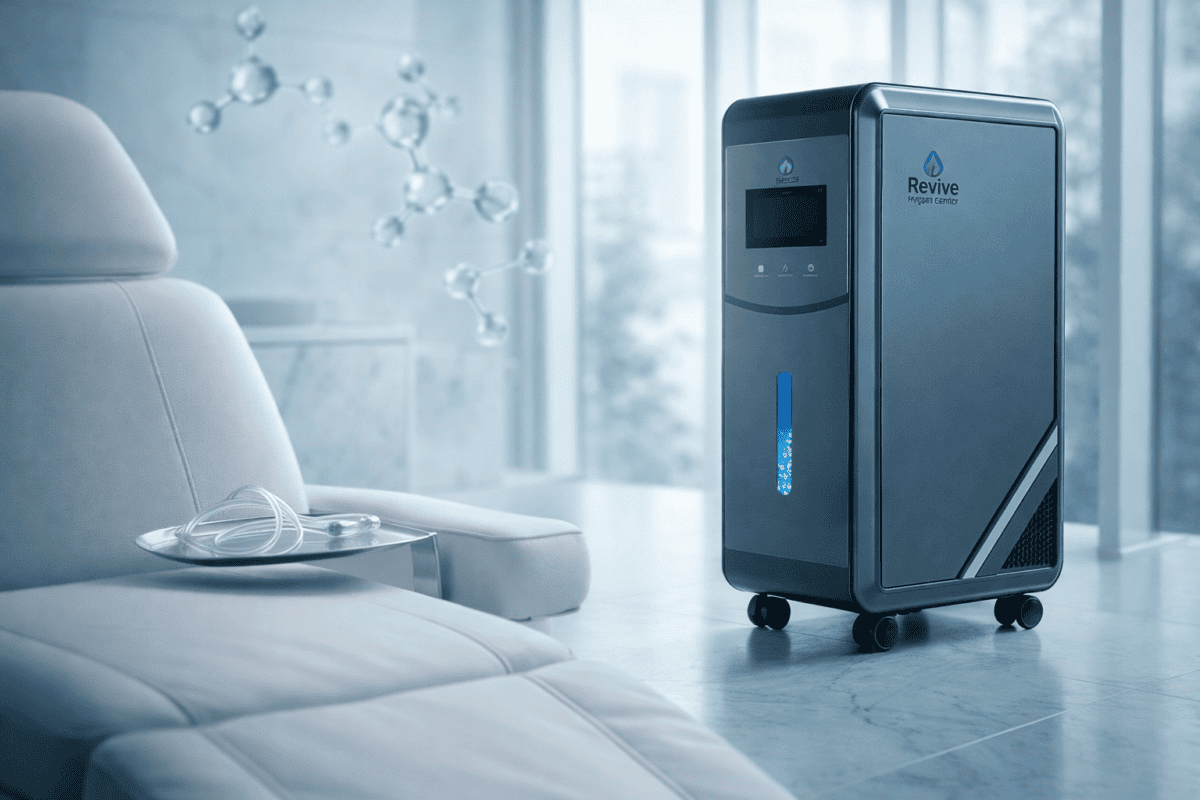
We build professional-grade PEM/SPE hydrogen inhalation systems specifically for sustained daily use, and we work directly with clinics and medspas.
The lineup:
| Model | Best suited for |
|---|---|
| HYD-1500 | Smaller practices, single-chair use, clinics piloting the modality — 900+ mL/min pure H₂ |
| HYD-1800 | Mid-volume clinics running consistent daily sessions |
| HYD-3000 | High-utilization facilities and dual-client sessions — up to 3,000 mL/min |
Specifications:
- Hydrogen purity of 99.992%, lab-certified
- PEM/SPE electrolysis using DuPont™ membrane technology and platinum-coated titanium electrodes
- Distilled water input only — no electrolyte solutions, no consumable cartridges, no filters
- Three operating configurations on every model: pure hydrogen, dual-user hydrogen via the included Y-connector, and oxyhydrogen
- Four nasal cannulas included with each unit
- CE (EMC/LVD) and RoHS documentation available on request
- Manufactured under an ISO 9001 quality management system
- Three-year warranty, with remote-first service — guided troubleshooting, video support, and parts shipped directly, so a unit is rarely out of rotation for long
For clinic partners specifically:
- Partner pricing on all models, structured so the unit pays for itself faster
- Net-30 ACH terms available via invoice for established practices
- Staff training on setup, session protocols, and client-facing education
- Compliance-reviewed client education materials you can put in your waiting room
Considering adding hydrogen inhalation to your clinic?
The fastest way to figure out whether this fits your practice is a short conversation. We will walk through your space, your utilization, your existing service mix, and your realistic session volume, and tell you honestly which model makes sense — or whether it makes sense at all.
Schedule a 15-minute intro call →
Or learn more about the Revive Hydrogen Partner Program.
New to hydrogen inhalation? Download our free Beginner’s Guide to Hydrogen Inhalation for a plain-language primer on what H₂ is, how inhalation works, and how to choose a generator.
Revive Hydrogen generators are general wellness devices. They are not intended to diagnose, treat, cure, or prevent any disease. Clinics should ensure their marketing and client communications comply with applicable FTC guidance and state regulations governing their practice.