

Before You Buy a $5,500 Hydrogen Machine, Ask Some Questions.
How much of that flow rate is actually hydrogen?
How long is the warranty?
Can two people use it?
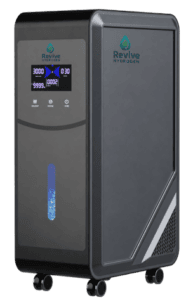
The Revive HYD-1800 delivers 1,200 mL/min of hydrogen — twice the output of a 600 mL/min machine — for $3,599. Here’s the full comparison, including the parts most companies don’t put side by side.
2× Hydrogen Output
1,200 vs. 600 mL/min H₂
3× Warranty
3 years vs. 12 months
Actually Try It
30-day in-home trial vs. unopened-only returns
Side by Side
| HLTH Machine | Revive HYD-1800 | Revive HYD-3000 | |
|---|---|---|---|
| List price | $7,000 | $3,599 | $4,299 |
| Current price | $5,500 at the webinar discount | Occasional discounts — see site | Occasional discounts — see site |
| Hydrogen output | 600 mL/min | 600 / 900 / 1,200 mL/min | 1,000 / 1,500 / 2,000 mL/min |
| Total gas | 900 mL/min | 900 / 1,350 / 1,800 mL/min | 1,500 / 2,250 / 3,000 mL/min |
| Adjustable output | No | Three flow levels | Three flow levels |
| Two users at once | No | Yes — splits across two ports (600 mL/min each at max) | Yes — splits across two ports (1,000 mL/min each at max) |
| Hydrogen purity | 99.99% (as advertised) | 99.992% verified | 99.992% verified |
| Warranty | 12 months | 3 years | 3 years |
| Return window | 15 days, unopened only | 30 days, and you’re meant to use it | 30 days, and you’re meant to use it |
Good, or better. The HYD-1800 matches the comparison above at $3,599. If you want more headroom — higher settings for congestion, altitude, or elevated breathing, and more room for two users at once — the HYD-3000 steps up to 2,000 mL/min of hydrogen for $4,299.
The math, plainly
We’ll use their discounted price, not their list price, because that’s what most buyers actually pay. We’re not discounting right now, so we’ll compare their discounted price to our standing price.
At $5,500 for 600 mL/min of hydrogen, you’re paying $9.17 for every mL per minute of output. The HYD-1800 delivers twice the hydrogen for about $1,900 less or $3.00/mL per minute. The HYD-3000 delivers more than three times the hydrogen for about $1,200 less.
The price difference matters — but the bigger question is what you get for the money.
Total gas flow is not hydrogen flow
Every hydrogen inhalation machine works by electrolysis — splitting water into hydrogen and oxygen in a fixed 2:1 ratio. That matters because of how output gets advertised.
A machine described as “900 mL/min” may be quoting total gas output. At the 2:1 ratio, that’s 600 mL/min of hydrogen and 300 mL/min of oxygen. The hydrogen — the part you’re actually paying for — is two-thirds of the headline number.
There’s nothing improper about quoting total flow. But if one product quotes total gas while another quotes hydrogen, you aren’t comparing the same thing.
One question settles it: Of your stated flow rate, how many mL per minute are hydrogen? Any manufacturer should be able to answer that in one sentence.
More isn’t automatically better. Adjustable is.
We’re not going to tell you that more hydrogen is automatically better. That isn’t how dosing works, and anyone selling you on flow rate alone is selling you the wrong number.
The measure that matters is FiH₂ — the fraction of hydrogen actually reaching your airway. A 2026 paper in Respiratory Research by LeBaron and colleagues concludes that flow rate alone cannot predict it. What you receive depends on your breathing rate, how clear your nasal passages are, whether you breathe through your mouth, and your elevation.
Two findings matter when choosing a machine:
- The practical therapeutic window is roughly 1–4% FiH₂. Below 1% is likely insufficient; above 4% adds flammability risk without demonstrated benefit.
- The flow needed to land in that window varies enormously between people — the paper’s modeling spans roughly 60 to over 5,000 mL/min. Notably, it finds that flows of 600–1,200 mL/min may still fail to reach even 1% depending on the person and the circumstances.
For an average adult breathing calmly at rest, 600 mL/min lands around 2% — inside the window. We’re not going to pretend otherwise. But congestion, mouth breathing, ordinary talking and movement, or higher elevation all reduce what reaches you, and roughly 15–25% of adults have nasal patency restricted enough to need about double the flow for the same result.
And you can’t measure it at home. Unlike oxygen, where a pulse oximeter gives you an instant reading, verifying FiH₂ requires laboratory gas chromatography. With a fixed-output machine, you could sit below the therapeutic threshold for an entire session with no signal that anything is wrong — no alarm, no readout, no way to compensate. Just a timer counting down.
Adjustability doesn’t solve the measurement problem — nothing on the market does. What it gives you is the ability to build margin: turn the flow up when conditions work against you, and back down when they don’t. Running high all the time isn’t the answer either, since exceeding 4% introduces flammability risk. There is no single flow rate correct for every person in every state. A machine with one output has picked one answer to a question that has many.
See the dosing science — what each setting actually delivers
Estimated FiH₂ for each HYD-3000 setting, using the same modeling approach as the paper at a typical resting inspiratory flow of 30 L/min. Hydrogen is two-thirds of total gas output and splits evenly across two ports.
| Setting (total gas) | H₂ output | One port | Both ports combined |
|---|---|---|---|
| 1,500 mL/min | 1,000 mL/min H₂ | 500 mL/min → ~1.7% | 1,000 mL/min → ~3.3% |
| 2,250 mL/min | 1,500 mL/min H₂ | 750 mL/min → ~2.5% | 1,500 mL/min → ~5% |
| 3,000 mL/min | 2,000 mL/min H₂ | 1,000 mL/min → ~3.3% | 2,000 mL/min → ~6.6% |
For most people at rest we’d suggest around 1,000 mL/min of hydrogen — one port at the highest setting, or both ports at the lowest. Either lands near 3.3%, inside the optimal 2–4% band.
We’re not hiding the right-hand column: at rest, combining both ports at the two upper settings puts you above 4%. We don’t recommend running there by default, and we’ll say the same on the phone. Those settings exist for conditions that warrant them — talking or moving rather than sitting still, restricted nasal passages, higher elevation — all of which raise inspiratory flow and pull the delivered percentage back down.
On the HYD-1800, the three settings deliver 600, 900, and 1,200 mL/min of hydrogen. Because that splits across two ports, a single user should combine both ports — which keeps every setting at or below 4%.
LeBaron TW, et al. Respiratory-physiology modeling of therapeutic hydrogen inhalation: defining the fraction of inspired hydrogen (FiH₂) and flow-rate requirements. Respiratory Research. 2026;27:259. Open access.
A home trial you can’t take isn’t a trial
| HLTH | Revive |
|---|---|
| 15 days | 30 days |
| Must remain unused and sealed | Use it at home — that’s the point |
| No return once opened or powered on | Used nasal cannulas don’t affect eligibility |
| 20% restocking fee on eligible returns | 10% + $45 shipping on change-of-mind returns |
| Defects: 7-day window, replacement only | Defects: full refund, we pay shipping |
| 12-month warranty | 3-year warranty |
Read the second row again. On a $5,500 purchase, you’re being asked to decide whether to keep the machine without ever turning it on.
We’d encourage you to read their policy yourself rather than take our summary for it.
What We Don’t Claim
Hydrogen is an interesting molecule and an active area of research. It is not a treatment for any disease, and anyone telling you otherwise is either uninformed or hoping you are.
We won’t tell you hydrogen cures, treats, or prevents any condition. We won’t share testimonials or anecdotes implying it did. We won’t present preliminary studies as settled science, or animal research as though it were human research.
We will tell you that molecular hydrogen is being studied for its role in the body’s antioxidant and inflammatory response pathways, that a substantial and growing body of research exists (over 2,000 studies), and that much of it remains early. We’ll point you to the Molecular Hydrogen Institute and other trusted sources and let you read the literature yourself.
Gary Vaterlaus, who founded Revive Hydrogen, holds an MHI H₂ Advisor credential. That’s not a medical credential and we won’t pretend it is. It means the specs on this page were written by someone who has read the underlying research.
If you want claims, there are people who will make them. If you want a straight answer about what a machine does and what the evidence supports, book a call.
Common Questions
Is oxyhydrogen the same as hydrogen?
No. Oxyhydrogen is the combined output of electrolysis — hydrogen and oxygen together in a 2:1 ratio. Hydrogen output is just the hydrogen. Our machines deliver hydrogen and oxygen through separate ports, with an optional Y-connector if you want to combine them. They’re different measurements, and quoting one while a competitor quotes the other makes comparison impossible.
Why does purity matter?
Our machines produce hydrogen at 99.992% purity via PEM/SPE electrolysis. Purity determines what else you’re inhaling alongside the hydrogen. It’s a specification worth asking any manufacturer to state in writing.
Which model should I buy?
For most single users, the HYD-1800 at $3,599 covers the therapeutic range comfortably. Choose the HYD-3000 if two people will use it regularly, if you’re at higher elevation, or if you want headroom for sessions where you’re talking or moving rather than sitting still. We’re glad to talk it through.
What flow rate should I actually use?
That depends on your goals and, ideally, a conversation with your healthcare provider. We’re glad to walk you through what the research describes and how the settings map to it. We won’t prescribe — that isn’t our role.
How long should a session be?
Research suggests at least 20–30 minutes is needed for hydrogen levels to equilibrate in the body, with longer sessions (60 minutes or more) common in published studies. Levels return to baseline within roughly 30–90 minutes after a session ends.
What if it arrives damaged?
Full refund or replacement, your choice, and we cover return shipping. Report it within the return window with photos.
The comparison we’d want you to make
Ask any company the same five questions:
- How many mL per minute of hydrogen — not total gas?
- What’s the purity, in writing?
- Can I use it and still return it?
- How long is the warranty, and what does it exclude?
- Does it support two users?
And do this before buying anything: search the exact specifications — the output numbers, the purity, the warranty, the build — not the brand name or who promotes it. Do it for ours too. We’d rather you bought knowing exactly what else exists with those specs than bought on our word alone.
Weighing us against a different machine? See all our comparisons, including AquaCure’s AC60, InhaleH2, Echo Refresh, and Qlife.
These statements have not been evaluated by the Food and Drug Administration. This product is not intended to diagnose, treat, cure, or prevent any disease. Comparative specifications and policies reflect information published by the referenced company as of September 2026 and may change; we encourage independent verification.