

Before You Buy an InhaleH2, Compare the Specs
InhaleH2 was co-developed by Dr. Tyler LeBaron — the same researcher behind the FiH₂ framework we cite throughout this site. It’s a genuinely well-engineered machine. It’s also $6,499, requires a sealed mask and breathing bag, and supports one user at a time.
$2,200+ Less
$4,299 vs. $6,499
Hands Free
Nasal cannula vs. strapped mask + breathing bag
Two Users at Once
Two ports, split output vs. a single mask
Side by Side
| InhaleH2 | Revive HYD-1800 | Revive HYD-3000 | |
|---|---|---|---|
| List price | $6,499 | $3,599 | $4,299 |
| Dosing approach | Targets a set FiH₂ concentration (0–4%) directly via active air mixing | Adjustable hydrogen flow rate (three presets) | Adjustable hydrogen flow rate (three presets) |
| Max hydrogen output | 480 mL/min H₂ (at 4% concentration, 12 L/min total flow) | 600 / 900 / 1,200 mL/min | 1,000 / 1,500 / 2,000 mL/min |
| Hydrogen purity | 99.995% (SPE-PEM, titanium/platinum electrodes) | 99.992% verified | 99.992% verified |
| Delivery interface | Sealed full-face or nasal mask, head strap, 3L breathing bag | Nasal cannula, hands-free | Nasal cannula, hands-free |
| Two users at once | No — single mask | Yes — total output splits across two ports (600 mL/min each at max) | Yes — total output splits across two ports (1,000 mL/min each at max) |
| Warranty | 3 years | 3 years | 3 years |
| Return window | 30 days, unused and unworn, original packaging required | 30 days, and you’re meant to use it | 30 days, and you’re meant to use it |
| Dispute resolution | Mandatory binding arbitration, class-action waiver | Standard consumer terms | Standard consumer terms |
| Replacement parts | HEPA filter $30 (replace every 6 months), headband $30, face mask attachment $50 | None | None |
At $4,299, the HYD-3000 costs $2,200 less than InhaleH2 while supporting two users at once instead of one.
That gap widens over time. InhaleH2 lists a $30 HEPA filter replaced every 6 months, plus a $30 replacement headband and a $50 face mask attachment as separate parts. Our HYD line has no consumable parts to replace — the price you see is the ongoing cost.
A genuinely different approach worth understanding
We should be upfront about this one: InhaleH2 isn’t selling hype. It was co-developed by Dr. Tyler LeBaron, whose 2026 Respiratory Research paper on the fraction of inspired hydrogen (FiH₂) is the same research we cite elsewhere on this site to explain why flow rate alone doesn’t tell you what’s actually reaching your lungs.
Their machine takes that problem head-on. Instead of offering an adjustable flow rate and asking you to work out what that means for FiH₂, InhaleH2 actively mixes hydrogen with HEPA-filtered air inside a closed reservoir to target a specific concentration directly — a more direct solution to the exact variability problem the FiH₂ research describes than a flow-rate dial is.
That said, targeting a concentration inside the machine and confirming that concentration is what actually reaches your airway are two different things. Their system’s accuracy depends on a consistent seal at the mask and an internal mixing model calibrated to typical breathing — a loose mask fit or a breathing pattern outside that model would affect delivered FiH₂ the same way an unaccounted-for variable affects a flow-rate-based system. Neither approach can be verified at home without laboratory gas chromatography. We’d rather say that plainly than pretend our flow-rate approach has solved a problem their concentration-targeting approach was specifically built to address, or that their approach has eliminated a limitation that applies to every hydrogen inhalation device on the market.
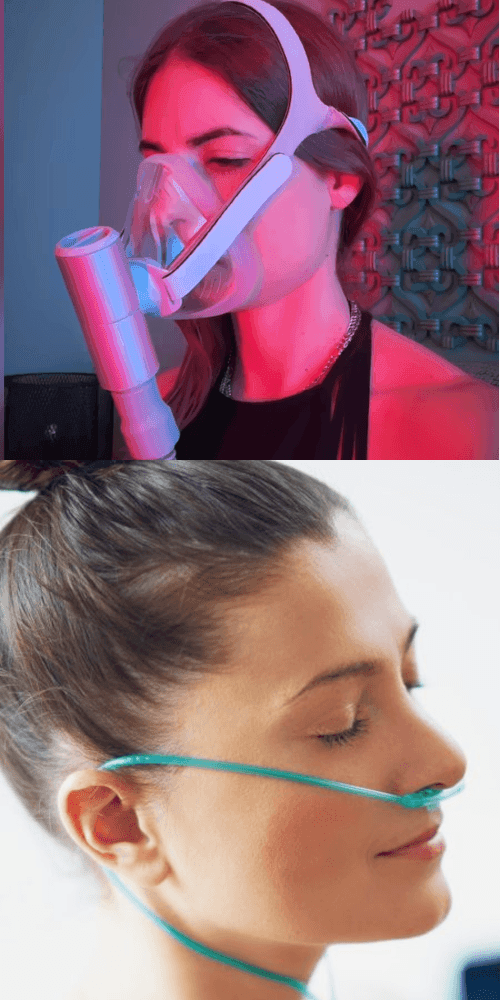
Mask and bag, or nasal cannula
InhaleH2’s closed-loop design needs a sealed interface to keep the mixing ratio accurate, so the system ships with both a full-face silicone mask and a nasal mask, secured with a head strap, connected to a 3-liter breathing bag that visibly inflates and deflates as you breathe. That’s the tradeoff for the precision described above — the seal is part of what makes concentration-targeting work.
It’s also a different daily experience than a nasal cannula. With a strapped mask on, talking clearly, reading, or using your phone is harder than it is with an open cannula, and you’re managing a breathing bag rather than just breathing. For a 20–60 minute session, done most days, that’s worth weighing against the precision gain — some people won’t mind, and others will find a hands-free nasal cannula the difference between a habit they keep and one they don’t.
Return policy and terms
InhaleH2’s return window is 30 days, matching ours in length — but the product must be unused and unworn, with all original packaging, labels, and tags, to qualify. On a $6,499 purchase, that means deciding whether to keep it without running a session.
Their refund policy also opens with a bolded notice that it carries a mandatory binding arbitration clause and a class-action waiver covering all claims against the company. That’s a standard structure for a lot of e-commerce terms, and not necessarily unusual — but it’s worth knowing it’s there before you buy, same as any policy term.
We’d encourage you to read their policy yourself rather than take our summary for it.
What We Don’t Claim
Hydrogen is an interesting molecule and an active area of research. It is not a treatment for any disease, and anyone telling you otherwise is either uninformed or hoping you are.
We won’t tell you hydrogen cures, treats, or prevents any condition. We won’t share testimonials or anecdotes implying it did. We won’t present preliminary studies as settled science, or animal research as though it were human research.
We will tell you that molecular hydrogen is being studied for its role in the body’s antioxidant and inflammatory response pathways, that a substantial and growing body of research exists, and that much of it remains early. We’ll point you to the Molecular Hydrogen Institute and other trusted sources and let you read the literature yourself.
Gary Vaterlaus, who founded Revive Hydrogen, holds an MHI H₂ Advisor credential. That’s not a medical credential and we won’t pretend it is. It means the specs on this page were written by someone who has read the underlying research — including Dr. LeBaron’s, which is why we can say honestly that InhaleH2’s approach to it deserves real credit rather than a dismissal.
If you want claims, there are people who will make them. If you want a straight answer about what a machine does and what the evidence supports, book a call.
The comparison we’d want you to make
Ask any company the same questions:
- How does the device get you into the therapeutic FiH₂ range, and how confident can you be that it does?
- What’s the delivery interface — hands-free cannula, or a sealed mask and bag?
- Does it support two users?
- Can I use it and still return it, and what does that actually cost?
- What happens if there’s ever a dispute — what terms am I agreeing to?
And do this before buying anything: search the exact specifications — not the brand name or who promotes it. Do it for ours too. We’d rather you bought knowing exactly what else exists with those specs than bought on our word alone.
Weighing us against a different machine? See all our comparisons, including Echo Refresh and Qlife.
These statements have not been evaluated by the Food and Drug Administration. This product is not intended to diagnose, treat, cure, or prevent any disease. Comparative specifications and policies reflect information published by the referenced company as of September 2026 and may change; we encourage independent verification.